 By Joel Paige
Cable attachments are often treated as interchangeable accessories. They are not. A rope, straight bar, angled bar and pair of independent handles can change wrist position, elbow path, available range and where an exercise becomes difficult. At a well-equipped fitness gym Singapore, attachment choice should follow the movement objective and the lifter’s tolerance, not whichever handle is closest.
The attachment does not independently make an exercise safe or effective. It changes the constraints. Those constraints can make a movement easier to organise, allow a more comfortable joint position or shift which muscles limit the set.
Start With the Line of Pull
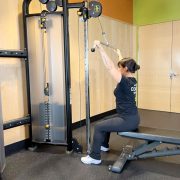
A cable applies force along the path between the handle and pulley. Changing the pulley height or body position can therefore matter as much as changing the grip. The attachment determines how the hands interact with that line.
A straight bar links both hands to one rigid object. The wrists and elbows must accommodate the bar’s fixed width and orientation. A rope permits some separation and rotation, although its two ends still share one cable. Independent handles provide the most freedom because each arm can find its own path.
This gives a useful selection order:
- Define the direction of force required.
- Choose a body position that creates that line.
- Select an attachment that allows the desired hand and elbow path.
- Test the movement under light load before progressing.
Beginning with a favourite attachment and inventing an exercise around it reverses the logic.
Straight Bars Offer Repeatability, With a Trade-Off
Straight bars are useful when symmetrical hand spacing and a repeatable endpoint matter. Pressdowns, curls, pulldowns and some rows can be easy to standardise because both hands move together.
The trade-off is reduced individual freedom. A fixed bar may encourage wrist extension during a curl or a wider elbow position during a pressdown, particularly when the user’s shoulder width and preferred forearm angle do not suit the bar. That does not make straight bars inherently problematic. It means the setup has to fit the person.
Use a straight bar when:
- bilateral symmetry is desirable
- a stable grip helps maintain output
- the fixed width feels natural through the full range
- load progression is easier to reproduce than with separate handles
Change the attachment or setup if discomfort appears consistently at the same joint angle, especially when technique and load have already been adjusted.
Neutral Handles Can Reduce Unnecessary Rotation Demands
Neutral grips position the palms more toward each other. Many lifters find this orientation comfortable for rows, pulldowns and presses because the forearm can align with the direction of movement without forcing full pronation or supination.
Comfort is individual, however. A neutral grip does not guarantee shoulder or elbow comfort, and a pronated grip is not automatically worse. Handle width, torso angle, pulley location and the user’s anatomy all interact.
The practical benefit of neutral handles is optionality. They offer another way to train the same broad movement pattern while changing the exact joint configuration. That can be valuable when a programme needs repeated pulling volume but one grip becomes locally irritating.
Ropes Change the End Range
Rope attachments are valuable because the hands can separate as the movement finishes. In a triceps pressdown, this may allow the hands to move beside the hips rather than stopping against a rigid bar. In a face pull, the rope can travel around the face while the elbows and shoulders rotate.
More range is not automatically better. The useful range is the portion that can be controlled while the target movement remains clear. Pulling a rope dramatically apart may create the appearance of extra motion while the shoulder or trunk supplies the final centimetres.
Evaluate a rope exercise by watching three points:
- whether the cable remains aligned with the intended motion
- whether the torso stays stable near the endpoint
- whether the extra range increases target-muscle effort or merely changes posture
Independent Handles Reveal Side-to-Side Differences
Two handles allow each arm to move without being constrained by the other. This is helpful for single-arm rows, presses, fly variations and curls. It can also expose asymmetries that a bar hides.
Independent movement does not require every exercise to become unilateral. Both arms can work simultaneously while retaining separate paths. The user can adjust wrist rotation through the repetition, which may make the exercise feel smoother.
The cost is greater coordination. With heavy loads, separate handles may be harder to stabilise, and small differences in path can grow as fatigue rises. A fixed attachment can sometimes be the better option when the goal is maximum repeatability.
Joint Comfort Is a Feedback Signal, Not a Diagnosis
Attachment selection should distinguish muscular effort from joint discomfort. A working muscle may burn or fatigue. Sharp, catching, electrical or escalating joint symptoms are different and should not be trained through casually.
Use a graded test:
- Reduce the load and repeat the movement slowly.
- Adjust pulley height or body position.
- Try a grip with more freedom, such as a rope or independent handle.
- Shorten the range only if the remaining range is controlled and purposeful.
- Stop and seek appropriate professional assessment if symptoms persist or worsen.
An attachment is a programming variable, not a treatment. It may improve tolerance by changing the position, but it cannot identify the cause of pain.
Compare Attachments With a Controlled Trial
To compare two grips fairly, keep the exercise, pulley setting, stance, tempo and target repetitions constant. Use a moderate load and record:
- target-muscle sensation
- joint comfort during and after the set
- stable range of motion
- repetitions before technique changes
- ease of reproducing the setup
Run each option for two or three sessions instead of making a decision from one set. Familiarity can make the first attachment feel better even when another becomes more effective after practice.
Match the Tool to the Programme Role
The same athlete can use different attachments within one week. A straight bar may suit a stable, progressively loaded movement. A rope may suit a higher-repetition exercise with a flexible endpoint. Independent handles may support unilateral work or a more individual wrist path.
This is one advantage of training in a facility with varied resistance equipment and attachment options. The user can select a tool for a specific line of pull rather than forcing every movement through one grip. The equipment range presented by TFX Singapore can be assessed most productively by testing how well each setup serves the programme, not by counting attachments alone.
Build an Attachment Log
Record attachment name, pulley height, stance distance and working load in the training log. A vague note such as “cable row” is not enough when several handles produce different mechanics. A precise setup improves progression and makes comfort patterns easier to identify.
Over time, the log may show that one grip supports heavier loading while another allows a longer comfortable range. Both observations can be useful. Exercise selection becomes stronger when it is based on reproducible evidence from the individual’s own training.
Frequently Asked Questions
Is a neutral grip always better for the shoulders?
No. It is one available orientation. Comfort depends on handle width, pulley position, movement path, load and individual anatomy.
Does a rope automatically increase triceps activation?
Not automatically. It changes hand freedom and endpoint options. The result still depends on elbow control, load, range and execution.
Should both sides use identical handle paths?
They should follow the same training intent, but minor natural differences may exist. Large or worsening differences deserve closer technical review.
When should an attachment be changed?
Change it when the current option prevents the intended path, repeatedly causes discomfort or makes progression unnecessarily difficult. Do not change it merely to create novelty.